Product Design · AI · Build
Aora
Finding the right job shouldn't mean reading hundreds of the wrong ones.
Aora is a job discovery and analysis tool I built to find relevant product design roles, understand what companies are actually looking for, and connect those requirements back to evidence from my own work.
Why I built Aora
Job hunting had started to feel like a job itself.
Roles were spread across company career pages and job boards. Descriptions were long, requirements were inconsistent, and working out whether my experience matched meant reading the same kinds of listings over and over again.
The AI tools I tried reduced all of that to a match score. A role might be a "92% match", but I couldn't see why.
I wanted a tool that could find relevant roles, understand what each company was asking for, and show me the actual evidence from my work behind each requirement.
My own job search was the first use case. Instead of designing for a hypothetical audience, I built around a problem I was hitting again and again, and used the product myself as I developed it.
So I built Aora.
How it works
01 Discover
Find roles worth looking at.
Aora starts with what I'm looking for: role, location, work style, salary and sponsorship. That brief shapes the opportunities I see.
Roles come straight from employers' Greenhouse, Ashby, Lever and Workable job boards, so each one links back to the real application.
64 employer job boards
02 Understand
See why a role fits, not just a score.
Aora reads the job description, pulls out each requirement and compares it with evidence from my experience.
Contribute patterns and components to modernise the design foundations and improve consistency and quality across the product.
EvidenceMontech → Worked on product experiences and reusable design system patterns.
Direct evidenceA real requirement from a Senior Product Designer role at Bumble, as Aora analysed it.
↳ Where the evidence comes from
My experience is the source of truth.
Aora doesn't guess who I am. It searches an experience library of my projects, responsibilities and outcomes, and nothing goes in until I've approved it. So every claim leads back to the statement it came from.
Design system patterns ← Montech: "Worked on product experiences and reusable design system patterns." Direct evidence
The same projects you'll find in this portfolio.
03 Prepare
Turn the analysis into something useful.
When I mark a role as interesting, Aora builds a workspace around it: the projects to lead with, gaps worth preparing for, relevant CV evidence and possible interview stories.
I can also paste an application question and get a first draft based only on evidence already matched from my experience.
Aora helps me prepare. It doesn't apply for me.
Three principles that shaped Aora
-
01
Evidence over percentages
Most job-matching products give you a number. Aora doesn't.
Every match points back to a specific piece of evidence, so I can see why something matched instead of trusting an unexplained score. A validator checks AI-generated citations against the source before they're shown.
-
02
Don't pretend to know
If Aora can't find evidence for a requirement, it says No evidence found. It doesn't turn that into "you don't have this skill".
The same goes for sponsorship. If a listing doesn't mention it, Aora says so instead of guessing.
-
03
Build it, don't just prototype it
I didn't want Aora to end as another Figma concept. I wanted to see how far I could take an idea myself, and to test my decisions in a product I actually use.
What I changed along the way
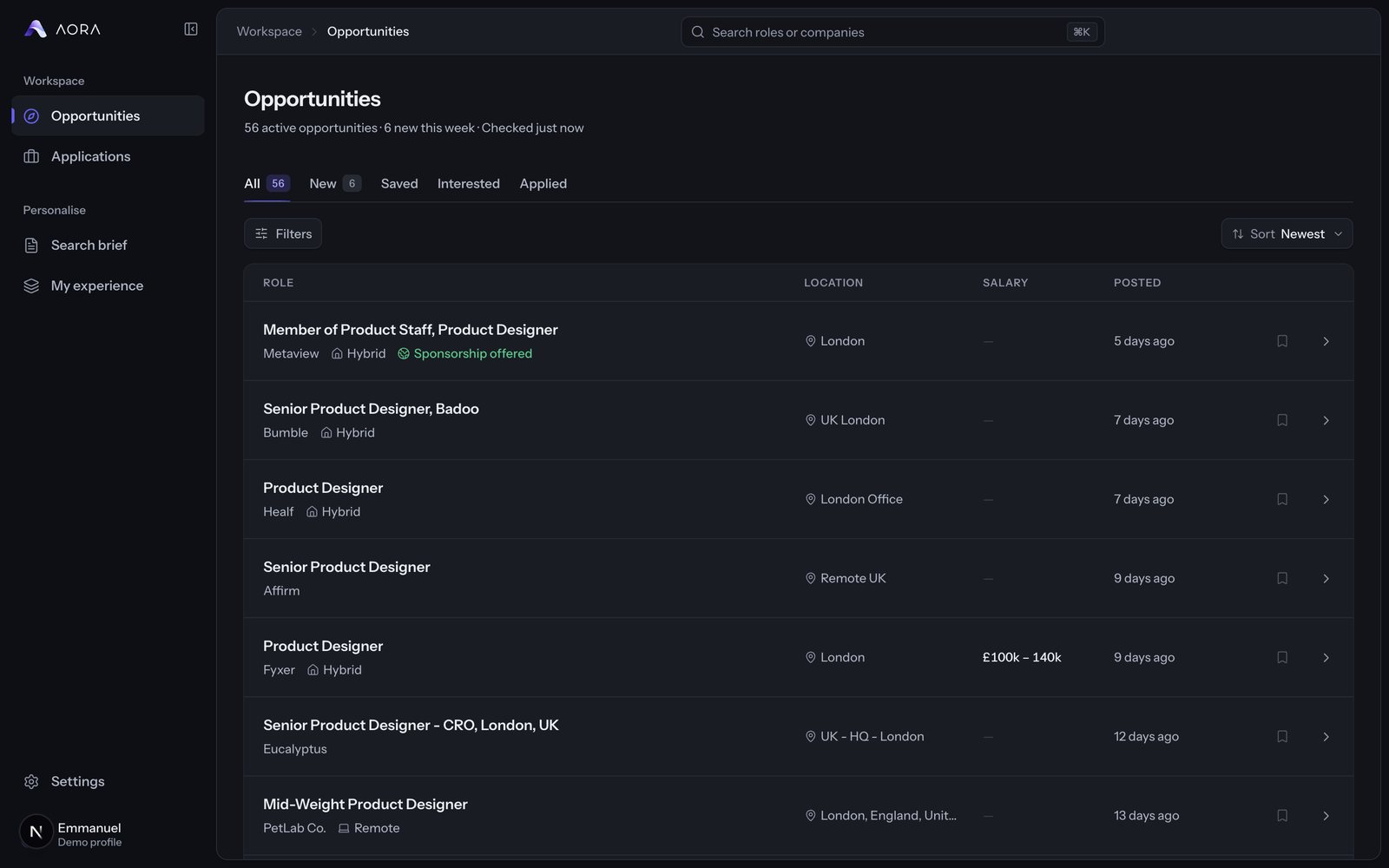
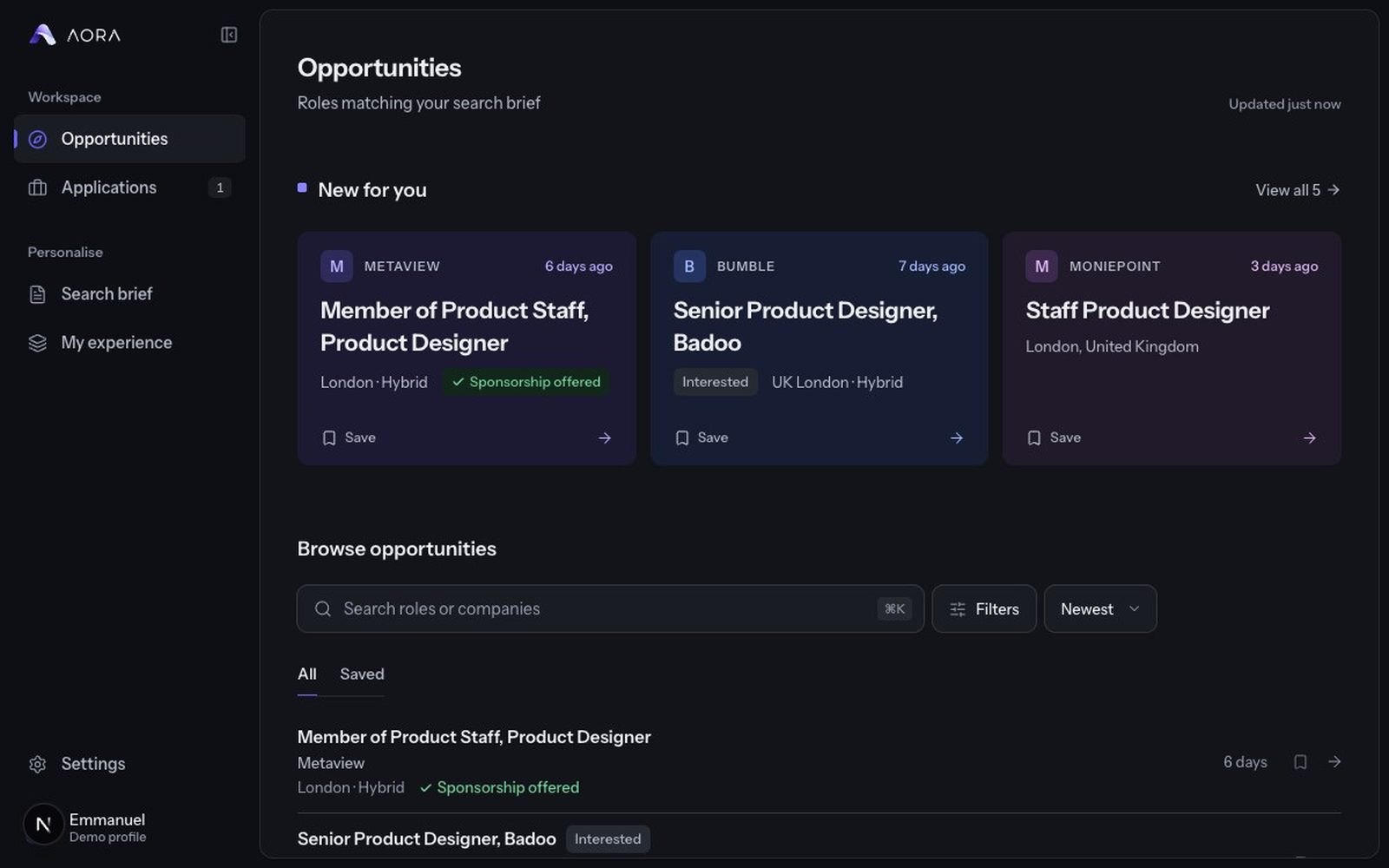
Using Aora showed me where my own design wasn't working. The Opportunities page is a good example.
 1
2
3
1
2
3
- Too many status signals
- Filters competed with the role drawer
- Everything had similar visual weight
 1
2
3
1
2
3
- Clear "New for you" and browse hierarchy
- One filter surface
- Role content gets priority
Light and dark
Aora follows the system theme, or you can switch it yourself. Both themes come from one set of colour tokens, and every screen was reviewed in both.
Trade-offs I made
-
Job data: accuracy over coverage
- Chose
- Employer job-board APIs
- Instead of
- A general job aggregator
I first used Adzuna for its coverage, but its descriptions were cut short, so Aora couldn't reliably read the requirements. Employers' Greenhouse, Ashby, Lever and Workable boards give complete descriptions and direct application links, at the cost of adding employers by hand.
-
AI model: structure over raw power
- Chose
- A cost-efficient OpenAI model with fixed-format outputs
- Instead of
- The largest available models
I compared Anthropic, OpenAI and Google. Every answer comes back in a format Aora can check, and the provider can be swapped without rewriting the product.
-
Analysis: on demand over instant
- Chose
- Analyse a role when I open it
- Instead of
- Analysing every role up front
Analysing the whole feed would cost far more for roles I may never open. The trade is a wait of up to a minute the first time a role is opened.
-
No accounts, yet: privacy over sync
- Chose
- Keep saved roles in the browser
- Instead of
- Sign-up and cross-device sync
No personal data on a server made the demo simple to share and safe to try. Accounts can come once other people add their own experience.
More technical decisions
- The simpler matcher, kept on purpose. I rebuilt the evidence matcher with a new selection process. It made the same mistakes on the same test listings, so I went back to the simpler version.
- Prep without extra AI calls. The CV and interview tabs reorganise evidence that's already matched, so they're instant and can't invent anything. Only the drafted answer calls the model, once.
Building changed how I design
I designed Aora and built it with Claude Code.
That meant I didn't have to stop at a prototype. I could make a decision, see it working in the real product, use it myself and change it when it didn't hold up.
I broke the product into 47 scoped stages. For each one, I defined the behaviour and requirements, reviewed the implementation through screenshots and screen recordings, tested it in both themes, and iterated before moving on.
- 64Employer job boards
- 47Reviewed build stages
- 232Automated tests
Claude Code · Next.js · TypeScript · OpenAI API · Figma
Where it is now
Aora isn't finished, and that's intentional.
I'm using it for my own job search, so I'm finding problems through real use instead of inventing hypothetical ones for a case study.
Right now it runs on my own experience. The next step is letting other designers add theirs, and testing whether what works for me holds up for them.
Have thoughts about it? I'd genuinely like to hear them.